
To get urine out of a mattress, strip the bed and blot up as much as possible with dry towels, pressing hard. Treat the area with an enzyme cleaner suitable for mattresses, let it work, then blot again. Once dry, cover it with bicarbonate of soda for several hours and vacuum. Never soak the mattress or use hot water or bleach.
Bedwetting, a poorly child, an older relative, a pet that sneaks onto the bed: urine accidents on a mattress are common and nothing to be embarrassed about. They do need dealing with quickly, though. Urine soaks in fast, and if it is left, the smell can linger for months. This guide explains exactly what to do, from the first minutes after an accident to tackling an old stain you have just discovered.
Urine is mostly water, but it also contains salts, urea and other compounds. When it dries, these stay in the mattress. Over time, bacteria break them down and release the strong ammonia smell people recognise. Warmth and moisture, like a body lying on the bed, make the smell stronger. That is why a mattress can seem fine during the day but smell at night.
The aim is to remove as much liquid as possible before it soaks in, then break down whatever is left so it cannot keep producing smell.
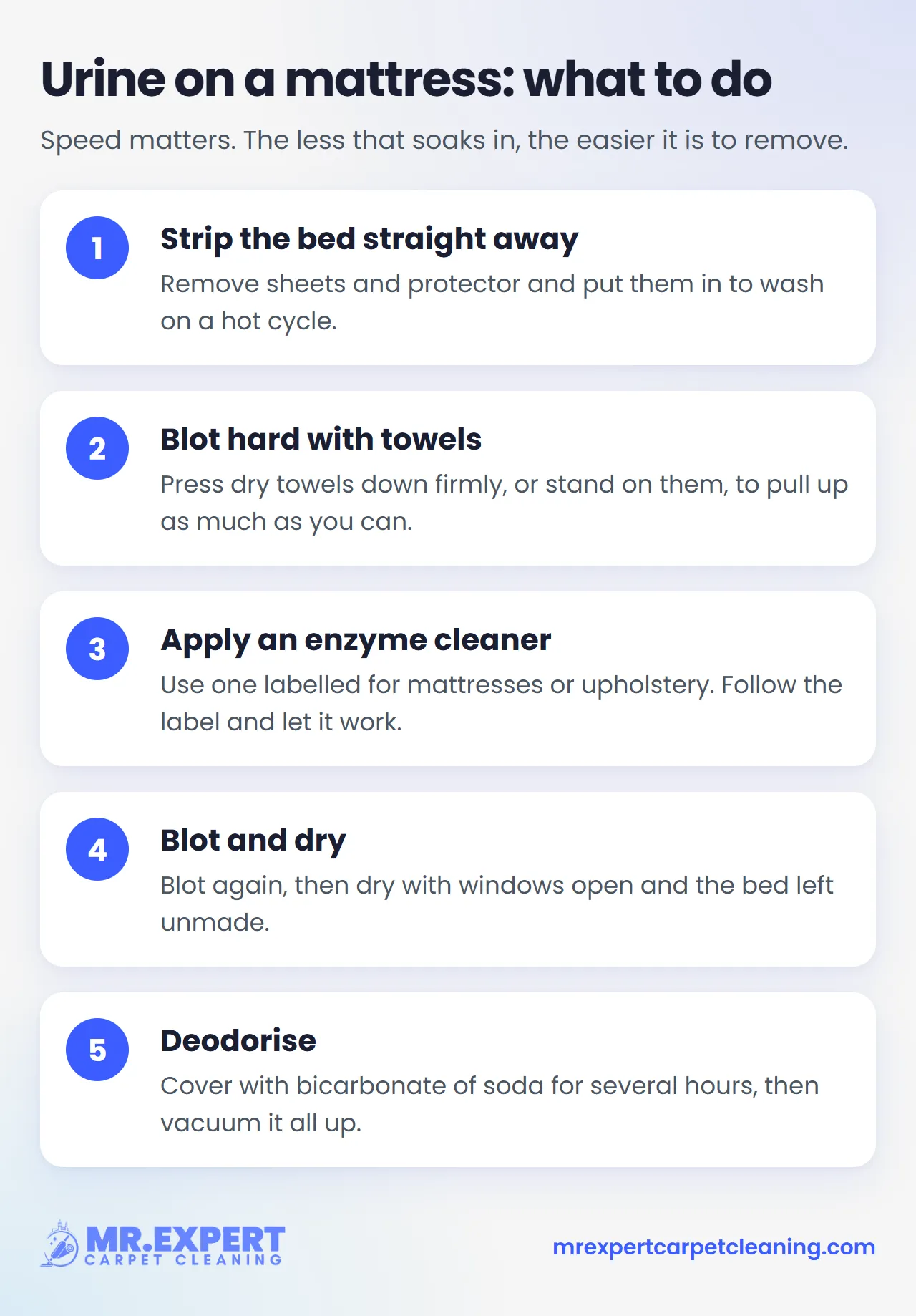
Take off the sheets, duvet cover and mattress protector. Rinse them in cold water and wash them on the hottest setting their labels allow. If you had a waterproof protector on, you may find the mattress itself is dry. That is the best possible outcome.
Fold a thick, dry towel and press it firmly onto the wet area. Stand or kneel on it to push it down. Swap to a dry towel and repeat until almost nothing more comes up. Rubbing just spreads the urine sideways and deeper.
Enzyme cleaners contain natural enzymes that break down the compounds in urine, which is what stops the smell coming back. Choose one that says it is suitable for mattresses or upholstery. Spray or dab it onto the affected area following the label, but do not drench the mattress. Most need some time to work before you blot them off.
Open the windows, turn on the heating or a fan, and leave the bed unmade. If you can, prop the mattress on its side so air reaches both faces. Do not use a hairdryer close to the fabric. Drying fully is essential, as trapped moisture brings the smell back.
Once the mattress is completely dry, sprinkle a generous layer of bicarbonate of soda over the area. Leave it for several hours, or overnight if you have somewhere else to sleep. Vacuum it all up with the upholstery tool.
Urine that has soaked deep into a mattress is hard to reach from the surface. A professional clean flushes and extracts it properly. Our team covers Slough and the surrounding area.
If you have found an old yellow stain with a smell, perhaps on a mattress in a new rental or a child’s bed, the steps are similar but slower:
Old stains often lighten but may not disappear completely, because urine can discolour the fabric over time. The smell is usually the bigger problem, and that is where a professional clean helps most.
Pet urine is treated the same way, but it is especially important to remove the smell fully. Cats and dogs often return to a spot that smells of urine. Use an enzyme cleaner, dry thoroughly, and keep the pet out of the bedroom until the mattress is fresh. If accidents are new or frequent, it is worth checking with a vet in case there is a health reason. Our guide to removing pet urine smell from carpet has more advice for pet owners.
Sometimes there is a smell but no obvious stain, especially on patterned mattress covers. A few ways to find the source:
Mark the areas with a pin or a piece of tape so you can treat exactly the right places.
| Remedy | Verdict |
|---|---|
| Enzyme cleaner | The most effective home option. Breaks down the compounds that cause smell. |
| Bicarbonate of soda | Good for absorbing remaining odour once the mattress is dry. |
| White vinegar and water | Can reduce smell a little but does not break urine down as well. Test first and use sparingly. |
| Washing-up liquid | Helps with the visible stain, less with the smell. |
| Fabric freshener spray | Masks the smell for a short time only. |
Bedwetting is very common in young children and usually stops on its own as they grow. While it is happening, a few simple things save a lot of work:
If you are worried about bedwetting, your GP or health visitor can give advice.
Most mattresses can be rescued after a single accident or even several, especially if they are treated quickly. Replacement is worth considering if the mattress was already old and unsupportive, if urine has soaked through repeatedly over a long time, or if a strong smell remains after professional cleaning.
Surface treatments work on the top layer. When urine has gone deeper, a professional clean is the most reliable way to remove the residue and the smell. Our team cleans single, double, king and super king mattresses across Slough and the surrounding area, using eco-friendly products that are safe for children and pets once dry. Find out more about our mattress cleaning service.
A mild solution of white vinegar and water can help neutralise smell on some mattresses, but it does not break down urine as well as an enzyme cleaner and leaves its own smell for a while. Test it on a hidden area first and use it sparingly.
After blotting and spot treatment, allow several hours in a warm, airy room, and longer for large accidents. Do not make the bed until it is completely dry, or the smell may come back.
Urine that reached deep into the mattress leaves salts and residue behind. Warmth and moisture from your body reactivate the smell. Surface treatment cannot reach it, so a professional clean is usually needed.
Old, dried urine is mostly a smell and staining problem, but it can attract dust mites and bacteria. Cleaning it properly, or replacing the mattress if it is badly affected, is the best option.
Call or WhatsApp for the fastest reply, or leave your details and we will get back to you.